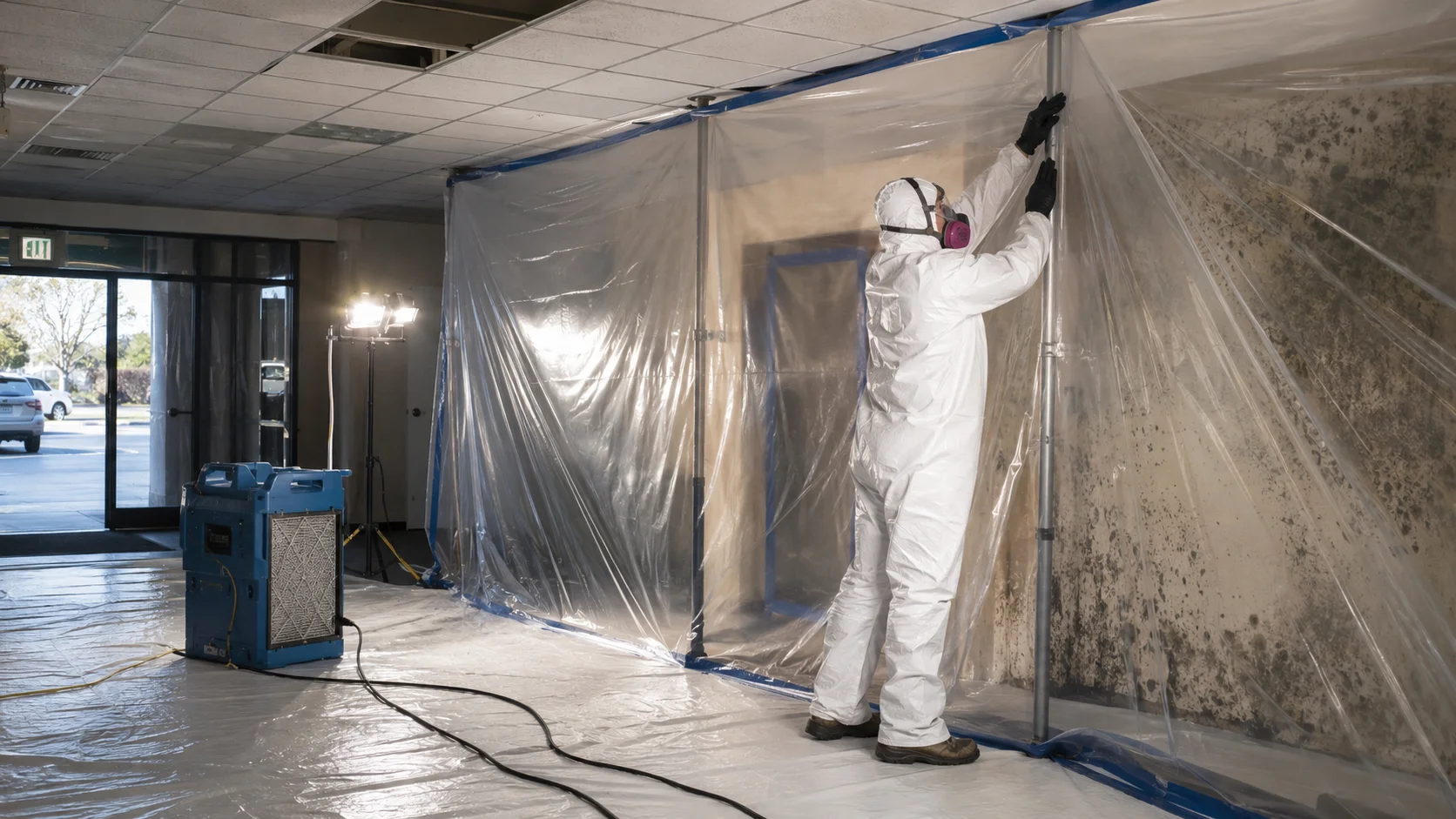
Mold remediation Modesto services exist because mold is one of the fastest moving and most underestimated threats a commercial building can face. After any water intrusion, whether from a roof leak, a burst pipe, an overflowing fixture, or storm damage, mold can begin to colonise damp materials within a day or two. For commercial property owners and property managers responsible for retail centres, offices, warehouses, and multifamily complexes, understanding how mold develops and how professional remediation works is essential to protecting both occupant health and the building itself.
Highly Favored Contractors treats mold as a moisture problem first and a cleaning problem second. Effective mold remediation Modesto work removes visible growth and corrects the water source, because cleaning alone simply guarantees the mold returns. This guide explains why mold spreads so quickly after water damage, the professional thresholds that determine when expert remediation is required, the containment and removal process, and how to prevent recurrence in the Central Valley climate.
Why Mold Spreads So Fast After Water Damage
Understanding why mold moves so quickly is the foundation of effective mold remediation Modesto work. Mold needs only three things to grow: moisture, a food source, and time. Commercial buildings supply the food source in abundance, since drywall, ceiling tiles, insulation, wood framing, and carpet are all organic materials that mold readily consumes. The missing ingredient is almost always moisture, and once water is introduced, the clock starts immediately. The EPA Water Damage Table for mold prevention sets out the widely referenced guideline that wet materials should be dried within 24 to 48 hours to prevent mold growth. After that window, the likelihood of colonisation rises sharply.
The EPA mold course on why and where mold grows identifies the moisture problems most often behind mold in buildings, including leaking roofs, condensing or leaking pipes inside wall cavities, leaking fire protection sprinkler systems, and landscaping or gutters that direct water toward the structure. High relative humidity above 60 percent can also sustain growth without any visible leak. In Modesto and across the Central Valley, the combination of summer heat and humidity inside poorly ventilated spaces creates conditions where mold can establish quickly once moisture is present.
Because mold spreads through airborne spores, a small problem in one area can seed growth elsewhere in the building, particularly through the HVAC system. This is why rapid response and professional containment matter so much. A water event that is dried promptly may never become a mold problem at all, which is why fast water damage restoration is the first and best defence against mold.
When Professional Mold Remediation Modesto Work Is Required
Not every spot of mold requires a full remediation crew, but commercial property owners should understand the recognised thresholds that trigger professional mold remediation Modesto services. The EPA guide to mold remediation in schools and commercial buildings provides the most widely used framework for commercial properties. It distinguishes between small isolated areas that trained building staff may handle and larger contaminated areas that call for professional remediation with full containment and protective measures.
The general thresholds property managers should know include the following points, drawn from the EPA commercial guidance.
• Areas smaller than about 10 square feet can often be handled by trained maintenance staff using appropriate precautions.
• Areas larger than about 10 square feet, up to roughly 100 square feet, call for more careful handling, containment, and protective equipment.
• Areas larger than about 100 square feet, contamination of the HVAC system, or growth caused by sewage or contaminated water require professional remediation and a documented plan.
The CDC mold cleanup guidelines reinforce that anyone with asthma, allergies, a compromised immune system, or chronic lung conditions should not take part in cleanup, and that larger contaminated spaces present real health and injury risks. For commercial buildings with tenants, employees, and visitors, this health dimension is a major reason to bring in professional remediation rather than attempting a large cleanup in house. Where mold has fed on structural wood, the work may also overlap with dry rot repair to restore weakened framing.
The Professional Mold Remediation Process
Professional mold remediation Modesto work follows a controlled sequence designed to remove mold safely while preventing spores from spreading to clean areas of the building. The steps below reflect how a thorough commercial remediation is carried out.
1. Identify and stop the moisture source. Remediation cannot succeed while water is still entering. The leak, condensation, or drainage problem is found and corrected first.
2. Assess and document the contamination. The extent of growth is mapped, including hidden areas behind walls or above ceilings, using moisture detection equipment where materials are not directly visible.
3. Establish containment. Polyethylene barriers and controlled work zones isolate the affected area so spores cannot migrate to clean parts of the building during removal.
4. Create negative air pressure. Air filtration equipment maintains negative pressure inside the containment, drawing air away from clean areas and capturing airborne spores.
5. Remove contaminated materials. Porous materials such as saturated drywall, ceiling tiles, insulation, and carpet that cannot be cleaned are removed, bagged, and disposed of properly.
6. Clean and treat remaining surfaces. Non porous materials are cleaned, and surfaces are treated to remove residual contamination.
7. Dry thoroughly and verify. The area is dried completely, then inspected to confirm the mold has been removed and the moisture problem resolved before reconstruction begins.
The CDC and EPA homeowners and renters guide to mold cleanup emphasises that cleanup must be complete and the moisture corrected before a space is reoccupied. In a commercial setting, that verification step protects the owner from reopening a building only to face a recurrence. Once remediation is complete, any removed drywall, insulation, or finishes are rebuilt, often alongside commercial painting and interior restoration to return the space to full use.
Preventing Mold From Returning
Because mold is always a moisture problem, prevention focuses on keeping buildings dry, and it is the natural companion to any mold remediation Modesto project. The single most effective measure is responding to any water event quickly, ideally within the 24 to 48 hour window, so materials never stay wet long enough for growth to begin. Beyond rapid response, ongoing prevention depends on maintenance and vigilance across the property.
• Maintain roofs, gutters, and drainage so water is directed away from the building, a task often handled through commercial property maintenance.
• Inspect and service HVAC systems, since condensation and contaminated ducts are common mold pathways, through regular HVAC services.
• Address plumbing leaks promptly, including slow leaks inside wall cavities, with professional commercial plumbing.
• Control indoor humidity and ensure adequate ventilation in high moisture areas such as restrooms and kitchens.
• Schedule regular inspections so small moisture problems are caught before they become mold problems.
For property managers overseeing several sites, building these checks into a preventative maintenance programme turns mold prevention from a reactive scramble into a routine part of operations, which protects both tenant health and the value of the asset.
Areas We Serve Across Modesto and the Central Valley
Highly Favored Contractors provides mold remediation Modesto services and related restoration work throughout the region. Service areas include Downtown Modesto, Salida, Empire, Riverdale Park, College Area, Village One, La Loma, and Coffee Sylvan, along with Stanislaus County communities such as Ceres, Turlock, Riverbank, Oakdale, Patterson, Hughson, Waterford, and Keyes. Coverage extends to Manteca, Lathrop, Ripon, Stockton, Atwater, and Merced, as well as the Tracy area across San Joaquin County. Property managers with multiple sites can review the full
areas we serve page to confirm coverage across the Central Valley.
Frequently Asked Questions
How quickly does mold grow after water damage?
Mold can begin to grow on damp organic materials within 24 to 48 hours of water exposure. This is why the EPA recommends drying wet materials within that window to prevent growth. In warm conditions, colonisation can happen at the faster end of that range. The most reliable way to prevent mold after a water event is rapid extraction and drying, ideally beginning within hours rather than days, before spores have a chance to establish.
When does mold require professional remediation in a commercial building?
Under widely used EPA guidance for commercial buildings, mold covering more than about 100 square feet, contamination of the HVAC system, or growth caused by sewage or contaminated water calls for professional mold remediation Modesto services with full containment. Smaller areas may sometimes be handled by trained staff, but for buildings with tenants and employees, professional remediation reduces health risk and ensures the moisture source and all contamination are properly addressed.
Is mold remediation covered by commercial property insurance?
It depends on the cause and the policy. Many commercial policies cover mold when it results from a sudden, covered water event, while excluding mold caused by long term maintenance issues or unresolved leaks. Documentation of the water source, the date of the event, and the mold remediation Modesto work completed is critical to any claim. Owners should review their specific policy language, since coverage and limits for mold vary significantly between carriers.
Can mold come back after remediation?
Yes, if the underlying moisture problem is not corrected. Mold remediation Modesto work that removes growth without fixing the leak, condensation, or drainage issue behind it will eventually fail. Effective remediation always identifies and resolves the water source first, then removes contamination, dries the area completely, and verifies the result before reconstruction. Ongoing maintenance and humidity control are what keep a remediated building mold free over the long term.
What health risks does mold pose in commercial buildings?
Mold exposure can trigger allergic reactions, asthma attacks, and respiratory irritation, and it poses greater risk to people with allergies, asthma, chronic lung disease, or weakened immune systems. The CDC advises that these individuals should not take part in cleanup or be present during it. For commercial buildings with employees, tenants, and visitors, this health dimension is a major reason to address significant mold growth with professional remediation rather than informal cleanup.
Conclusion
Mold is a moisture driven threat that can take hold within a day or two of water damage and spread quickly through a commercial building. Effective mold remediation Modesto work always begins by stopping the water source, then safely contains and removes contamination before drying and verifying the space. By responding to water events quickly and maintaining buildings to stay dry, commercial property owners and managers across the Central Valley can protect occupant health and preserve the long term value of their properties.
More Services
For more information about Cleaning and Restoration and related services at Highly Favored Contractors, explore the categories below:
• Cleaning & Restoration
• Mold Remediation
• Water Damage Restoration
• Fire Damage Restoration
• Facilities Maintenance & Repairs
• Commercial Property Maintenance
• Preventative Maintenance Programs
• Mechanical, Electrical & Plumbing (MEP)
• HVAC Services
• Commercial Plumbing
External Sources Used (for reference only)
• https://www.epa.gov/mold/mold-remediation-schools-and-commercial-buildings-guide-chapter-1 — US EPA, Mold Remediation in Schools and Commercial Buildings Guide, Chapter 1
• https://www.epa.gov/mold/water-damage-table-mold-prevention-mold-remediation-schools-and-commercial-buildings — US EPA, Water Damage Table: Cleanup and Mold Prevention
• https://www.epa.gov/mold/mold-course-chapter-2 — US EPA, Mold Course Chapter 2: Why and Where Mold Grows
• https://www.cdc.gov/mold-health/about/clean-up.html — US CDC, Mold Clean Up Guidelines and website Recommendations
• https://www.cdc.gov/mold-health/communication-resources/guide-to-mold-cleanup.html — US CDC, Homeowners and Renters Guide to Mold Cleanup After Disasters